

INQA-Coaching: 80% funding for SMEs
INQA-Coaching funds up to twelve consulting days at 80 percent, so that small and medium-sized enterprises can master digital transformation together with their employees. Here is how the program works, and how you can access the funding.
Many small and medium-sized enterprises leave funding on the table, often without realizing it. One of the most interesting programs for digital transformation is INQA-Coaching: it covers 80 percent of the cost of professional consulting that helps you make your company fit for the future together with your employees.1 This article explains what is behind it, exactly how much money is involved, who receives it, and what the path from the first inquiry to reimbursement looks like.
What is INQA-Coaching?
INQA stands for the Initiative Neue Qualität der Arbeit (New Quality of Work Initiative), launched by the Federal Ministry of Labour and Social Affairs back in 2002. Its guiding idea, backed by more than twenty years of practice, is simple: economic success and good working conditions belong together. The initiative is nonpartisan and supported jointly by the social partners, bringing together the federal government, the states, employer associations, trade unions, and other partners under one roof.
INQA-Coaching is the central funding program of this initiative. It helps companies handle personnel-policy and work-organization changes driven by digital transformation independently and sustainably. It is financed from the European Social Fund Plus (ESF Plus) and from federal funds.2 The underlying idea matters here: this is not about a quick one-off measure, and it is not about a consultant handing you a finished plan. It is about enabling your company to recognize the need for change itself, initiate processes, and test them within the business. The coach accompanies the process; the solution takes shape within your team.
How much funding is available?
For most people, this is the decisive question, so here it is step by step.
- Up to twelve consulting days of eight hours each are funded.
- The daily rate is capped at 1,200 euros net.
- The funding rate is 80 percent. You cover the remaining 20 percent yourself.1
A worked example makes this tangible. If you use all twelve days, the consulting costs come to twelve times 1,200 euros, that is 14,400 euros net. The funding covers 80 percent of that, which is 11,520 euros. Your own contribution is 2,880 euros. For a structured, multi-month change project with external support, that is a remarkably small amount.
One detail you should plan for from the start: the reimbursement principle applies. The company initially pays upfront and covers the consulting in full from its own funds. The 80 percent is reimbursed only after the coaching is completed and fully reviewed by the approval authority. So you need the full amount in the short term, but you get most of it back. Ancillary costs such as travel or materials are not eligible for funding; the coach can invoice those separately.
Behind the 80 percent stand two funding pots that together make up the total: funds from the ESF Plus and federal funds. How they are split depends on the region. In the more developed regions, roughly the old federal states, up to 40 percent comes from the ESF and 40 percent from the federal government; in the transition regions, roughly the new federal states, it is up to 60 percent ESF and 20 percent federal. For you as a company, that changes nothing: in both cases the funding rate is 80 percent. It is simply the background to why two sources are sometimes mentioned.
Who is eligible for funding?
The program is aimed at small and medium-sized enterprises (SMEs). The EU definition applies:
- fewer than 250 employees in the last completed financial year, and
- either at most 50 million euros in annual turnover or at most 43 million euros in balance sheet total.
On top of that, a few program-specific conditions apply. Your company must have been on the market for at least two years and have at least one full-time position subject to social insurance contributions. Eligible applicants are legally independent companies, members of the liberal professions, and nonprofit organizations with their registered office and place of business in Germany. Companies consisting only of mini-jobs are excluded, as are companies in insolvency. A de minimis threshold also applies: other state aid, combined with the planned coaching, must not exceed a certain threshold within three years. And finally, the funding can be used only once per company.
One important principle upfront, which surprises many: coaching with the stated goal of workforce reduction is explicitly not eligible for funding. This is about shaping good work, not the opposite.
What does it cover in practice?
So that you do not start from zero, the program works with a reference model, the six fields of action for shaping the work of the future. They help you find a sensible starting point. There is deliberately no single right path here, and the boundaries between fields are fluid. During the initial consultation, one or two priority fields are identified and later formally fixed.
The six fields at a glance:
- New business models and innovation strategies: How do you respond quickly enough to changing markets?
- Production models and work organization: How does digitalization change daily work?
- Personnel policy, employment, and qualification: Is everyone ready for the digital world of work?
- Social relations and culture: How firmly is participation anchored in the company?
- Leadership, professional development, and career: How do you attract and retain skilled workers?
- The workplace of the future, working time, and performance: What will work look like at your company going forward?
Above all these fields stands digital transformation, and running through all of them is a principle that sets INQA-Coaching apart from classic consulting: consistent employee involvement. Employees are not merely informed about outcomes, they help develop and test the solutions. That is exactly what makes changes sustainable, because they are not imposed from above but carried jointly.
How does the process work?
The path to funding follows a fixed sequence. It looks formal at first glance, but it can be explained in a few steps.
- Free initial consultation. You contact a regional INQA advisory office (IBS). This initial consultation is neutral, standardized nationwide, and free of charge. The IBS uses a checklist to check whether your company is eligible for funding, and helps determine the right field of action and the appropriate role model.
- The funding voucher. If the requirements are met, the IBS issues an INQA-Coaching voucher through the funding portal. It records the scope of consulting and the recommended priorities.
- Choose a coach yourself. Now you search for an authorized coach yourself from the public INQA-Coaching pool at inqa.de. Important: the advisory office is explicitly not allowed to recommend or place a coach for you, because all coaches are meant to have an equal chance at an assignment. The choice is entirely yours.
- Delivery. The coaching runs over four to seven months in three phases, usually on site at the company, or fully or partly digital if needed, as long as no one is excluded as a result.
- Reimbursement. After completion, you submit the reimbursement application to the approval authority. You paid upfront and get 80 percent back.
- Closing meeting. A few months later there is a closing meeting with the advisory office, and your company receives a certificate of participation.
Who does what? The roles in the coaching
So that involvement does not remain just a good intention, INQA-Coaching works with clearly defined roles. Which model applies depends on company size, measured in full-time equivalents at kick-off.
In the classic model (roughly ten to under 250 employees), there are three roles. The steering committee, made up of management and employees, guides the overall project and evaluates progress. The lab team, consisting of at least two employees and explicitly without management, is the heart of the process: it identifies the topics, develops solutions, and tests them in everyday work. A responsible person within the lab team acts as the central point of contact and may additionally receive brief one-on-one coaching.
In the small model (roughly one to under ten employees), everything is leaner: a steering session sets goals and a work plan, and in the lab phase, management and employees work together directly. In very small companies, roles may also be doubled up. In both models, the same rule applies: in at least one of the three working phases, the team works without management, so that employees get real room to shape outcomes and are not merely giving their approval.
What does the agile method look like in practice?
The methodological approach is binding for the funding; only the time invested can be adjusted. It follows three phases.
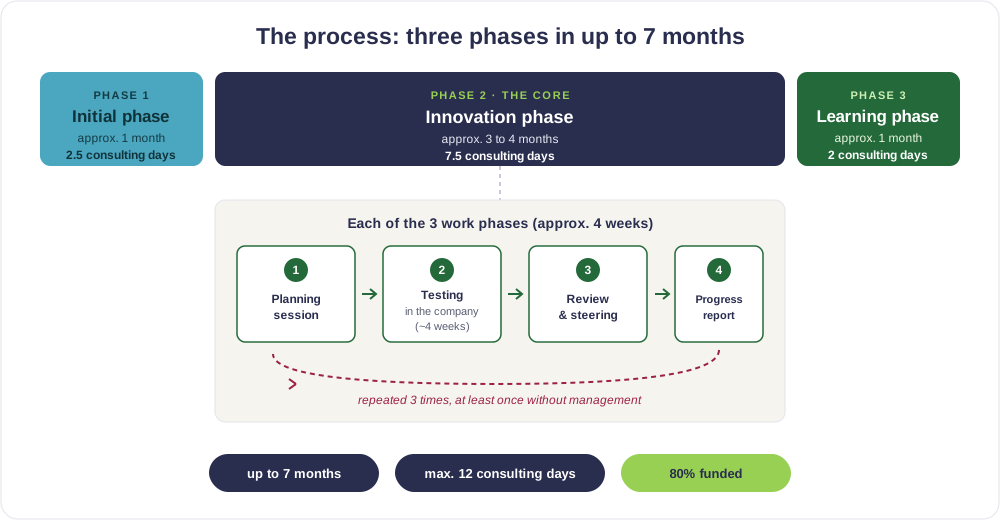
The process at a glance: three phases, the working model of one working phase, and the key funding figures.
In the initial phase (about one month), the coach lays the groundwork: conducting short interviews with key people, sharpening the topics, and moderating a kick-off workshop in which the fields of action are formally fixed and the roles are assigned.
The innovation phase (about three to four months) is the heart of the process. It consists of three working phases of roughly four weeks each. In each one, the team plans, tests in everyday work, evaluates, and documents. A dedicated team, the lab team, develops and tests the solutions, explicitly without management in at least one of the three phases, so that employees really do get room to shape outcomes.
The final learning phase (about one month) evaluates the results, secures the lessons learned, and clarifies how to continue independently. What remains in the end is not just an outcome, but a new way of approaching change within the company.
What deadlines do you need to keep in mind?
A few dates set the pace, and they are tight enough that early planning pays off. After the voucher is issued, you have seven months to complete the coaching. The application for cost reimbursement must then reach the approval authority within one month after the end of the coaching. No extension is possible, and nothing is funded retroactively. It is also important that the coaching must not have been contractually agreed before the initial consultation, or eligibility for funding is lost.
This comes with proper documentation, handled by the coach: minutes of the kick-off workshop, three progress reports for the working phases, and a final report, each provided promptly. That sounds bureaucratic, but it has a practical core: the reports capture what you tried and learned, and that is ultimately the real return of the coaching, far beyond the funded days themselves.
Until when is it available, and what else should you know?
The current funding guideline is limited until 31 December 2027.1 Anyone wanting to use the program should keep this timeframe in mind. Two further points matter. First, there is no legal entitlement to funding; the approval authority decides within the framework of available funds, and the voucher alone is not yet a binding commitment. Second, the coaching counts as complete only once all evidence has been properly submitted, which is why clean documentation belongs in the process from the start.
You should also keep in mind that the funding can be used only once per company and cannot be combined with certain other programs serving the same purpose. It is therefore worth using this one coaching for a topic that really makes a difference for your company.
Why does it pay off right now?
Digital transformation is no longer a distant topic for small and medium-sized enterprises, it is everyday business. New tools, artificial intelligence above all, are changing how work gets done in offices, workshops, and labs, and doing so quickly. The technology itself is rarely the real problem. The challenge lies in the organization: how do you introduce new tools so that they are actually used in everyday work? How do you bring the workforce along instead of running over them? How do you anchor change so that it does not fade once the initial enthusiasm wears off?
INQA-Coaching addresses exactly these questions. It does not force anyone toward a particular technology, but instead creates the structure in which a company finds and tests its own answers, in a participatory way and with measurable results. The fact that the state covers 80 percent of the cost turns a sensible undertaking into a very well calculable one. And because the program is limited until the end of 2027, the right time to look into it is sooner rather than later.
In short, INQA-Coaching is one of the most attractive instruments for not just planning change in small and medium-sized businesses, but actually implementing it, and at a fraction of the usual cost. If you are already thinking about how your company deals with digitalization, securing skilled workers, or new forms of work organization, calling your nearest advisory office is almost always worth it. The first step costs nothing but a bit of time, and it can be the beginning of a change your whole team will support.
Sources
- Federal Ministry of Labour and Social Affairs (BMAS). Funding guideline INQA-Coaching. BAnz AT 17.06.2024 B2, 11 April 2024, limited until 31.12.2027.
- Initiative Neue Qualität der Arbeit (INQA). Overview of INQA-Coaching. inqa.de
Funded coaching for your company?
We support your change in the workplace, funded at 80 percent through INQA-Coaching.
Frequently asked questions
How much funding does INQA-Coaching provide?
Up to twelve consulting days of eight hours each are funded, at a maximum daily rate of 1,200 euros net, and at a rate of 80 percent. If you use the full amount, around 2,880 euros remain as the company's own contribution. The money is reimbursed after completion, so the company has to cover the cost upfront.
Who is eligible for funding?
Small and medium-sized enterprises with fewer than 250 employees and at most 50 million euros in annual turnover or 43 million euros in balance sheet total, based in Germany, active on the market for at least two years, and with at least one full-time position subject to social insurance contributions. Funding can be used only once per company.
Does the advisory office recommend a coach to me?
No. The INQA advisory office is obligated to remain neutral and may not place or recommend coaches. You choose your INQA coach yourself from the public INQA-Coaching pool at inqa.de.
Until when does the program run?
The current funding guideline is limited until 31 December 2027. There is no legal entitlement to funding; the approval authority decides within the framework of available funds.